2026 Spring Housing Market Update – Not really looking all green!!

With sales of existing single-family houses and condos sputtering in the first three months of the year, experts now expect a modest improvement in the housing market for the remainder of 2026 rather than a robust one.

  • The National Association of Realtors cut its 2026 forecast for existing?home purchases from a 14% jump to a 4% rise after sales fell in March.
  • Higher mortgage rates — now expected to average about 6.5% for the year — along with weak consumer sentiment, a soft jobs market and the Iran war’s impact on borrowing costs and gas prices are weighing on buyers and sellers.
  • Inventory remains tight at 1.36 million homes, with regional sales declines across the U.S., particularly in the Northeast, despite modest affordability improvements nationwide.

Purchases of previously owned homes are likely to increase 4% for the year, Lawrence Yun, National Association of Realtors chief economist, said in a press call Monday. That’s down from the 14% projected rise Yun offered last fall. He provided the revised assessment along with a report that sales fell 3.6% in March, to a seasonally adjusted annual rate of 3.98 million homes. Sales were down 1% from the same month last year.


Courtesy – Homes.com – Click to read full article.
HOUSTON HOME AFFORDABLITY GETS BETTER BUT STILL HIGH

Housing affordability improved in the Greater Houston area as mortgage rates declined slightly in the second quarter of 2025, according to the Houston Association of Realtors’ latest Housing and Rental Affordability Report.

HAR’s Housing Affordability Index shows that 39 percent of Houston-area households could purchase a median-priced home in the second quarter of the year, which is improvement from 37 percent during the same time in 2024.

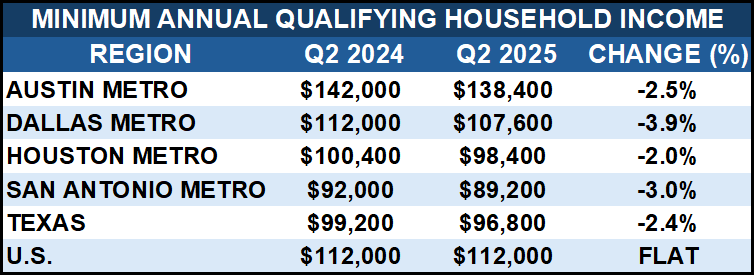
The median home price declined 0.6 percent year-over-year to $349,400. This comes as the average mortgage rate edged down to 6.79 percent from 7.00 percent in the second quarter of last year. The monthly payment on a 30-year fixed-rate mortgage, including principal, taxes and insurance, was $2,460 compared to $2,510 last year. Houston area households needed to make a minimum annual income of $98,400 to buy a typical home, which is down 2.0 percent compared to the same time last year.

Affordability also improved across Texas in the second quarter, with 39 percent of households able to buy a median-priced home compared to 36 percent during the same time in 2024. A minimum annual income of $96,800 was needed to qualify for the purchase of a $344,660 home statewide.

The national median home price edged up by 1.7 percent year-over-year to $429,400, according to new data from the National Association of Realtors. NAR reports that home prices increased in 75 percent of metro areas in the country in the second quarter of 2025. Thirty-four percent of households nationwide could afford the median-priced home.


Housing Market – Mid year update

Courtesy – Homes.com

The nation is halfway through 2025 — a year that was slated to offer lower mortgage rates, subdued home prices and more properties for sale. Some of those predictions have come to pass. Still, experts watching the housing market closely say U.S. economic uncertainty has bogged down what should have been months of hyperactive homebuying and selling.

Mortgage rates have flirted with 7% all year, a trend economists blame for why more buyers haven’t closed on a property. Rates will likely move depending on how — or whether — the Federal Reserve tweaks its benchmark rate. Meanwhile, median home sale prices are still rising — just not as much in big cities.

There is a silver lining: As Americans grapple with a nationwide housing shortage, inventory is rising for new and existing properties. That means homebuyers, depending on where they’re looking to move, should have a decent number of options once mortgage rates adjust to their liking, economists say.

Here’s a closer look at how mortgage rates, home prices and listing inventory have fared in the first six months — along with a taste of what experts expect for the rest of the year.

Check full report homes.com

What happened to starter homes less than 150k?

  • Starter homes under 1,400 square feet now make up just 9% of new builds, down from 40% in 1982. Rising construction costs, limited land, and restrictive zoning laws are key factors behind this decline.
  • Home prices have surged over 52% nationwide from January 2020 to October 2024, while labor and material costs rose by 50% over the last decade. Land prices have climbed two and a half times more, making affordability a major issue.
  • First-time homebuyers face record-high barriers, with their median age reaching 38 in 2024, compared to 29 in 1981. Meanwhile, an unusual market dynamic shows low first-time buyers but a high number of cash buyers.
  • Homebuilders say they are contending with rising construction costs and limited availability of land in addition to government red tape.
  • The death of the starter home sped up after the 2007-2008 global financial crisis as the homebuilder industry consolidated. The annual rates for new home construction remains well below those observed in the early 2000s and years prior.
  • “It is such an unusual market because we have an all-time low of first-time home buyers, but an all-time high of all-cash buyers,” said Jessica Lautz, deputy chief economist at the National Association of Realtors.

Courtesy of CNBC.com, read more at their website

10 best states to raise a family

  • Massachusetts ranks as the best state for raising families, despite its high costs, with a median list price of $985,000. It excels in education, job security, and health care quality, including the lowest infant mortality rate in the country.
  • Minnesota secures second place with a median family income exceeding $104,000 and the second-lowest poverty rate. The state is noted for its excellent public health systems and high rates of family stability with a low divorce rate.
  • North Dakota ranks third, with families spending just 16.5% of their income on average annual rent. It also shines in child care quality, with the second-highest number of daycares per capita and one of the nation’s lowest separation rates for families.

Courtesy of Realtor.com – Read more at Realtor.com